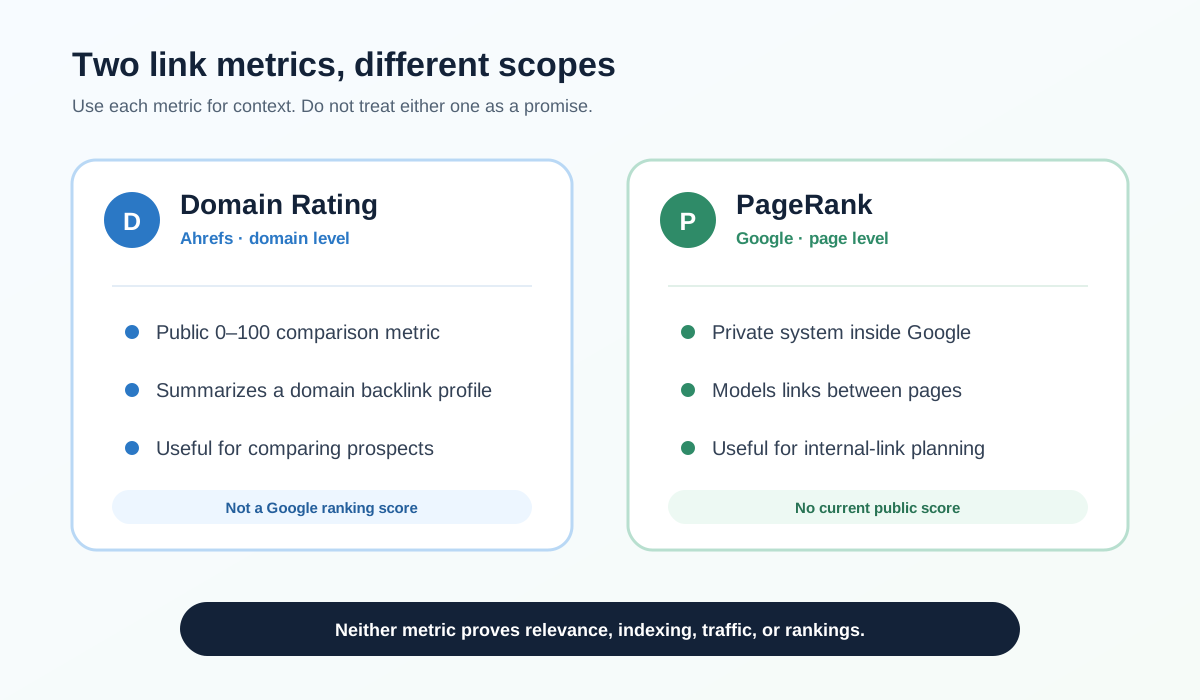
Domain Rating and PageRank both describe link-based authority, but they answer different questions. Domain Rating is Ahrefs' visible, site-wide estimate of backlink-profile strength. PageRank is Google's internal, page-level system for evaluating importance through links.
The terms are often blended into a vague idea of "authority." That creates bad decisions: founders sort every link opportunity by DR, describe DR as a Google score, or assume a link from any page on a strong domain must be valuable.
Domain Rating vs PageRank at a glance#
| Question | Domain Rating | PageRank |
|---|---|---|
| Who created it? | Ahrefs | Google founders Larry Page and Sergey Brin |
| What is the scope? | Entire domain | Individual web page |
| Is the score public? | Yes, through Ahrefs tools | No current public Google score |
| What scale is used? | Proprietary logarithmic 0–100 scale | Internal system; original formula was published, current values are private |
| Primary input | Backlink profile in Ahrefs' index | Links between pages in Google's systems |
| Is it a Google ranking factor? | No | PageRank concepts remain part of Google's ranking systems |
| Best practical use | Compare domain backlink strength | Understand page-level link flow and internal linking |
What Domain Rating tells you#
Ahrefs defines Domain Rating as the strength of a website's backlink profile on a logarithmic 0–100 scale. It considers referring domains, their DR, how broadly those domains link out, and followed link behavior in Ahrefs' model.
DR is efficient. It reduces a complex backlink graph to one comparable number. That makes it useful for prospecting and monitoring. It also creates a temptation to treat the summary as the thing itself.
A high DR does not reveal whether the exact page is strong, relevant, indexed, editorially credible, or likely to send a visitor. It cannot confirm how Google evaluates the link.
What PageRank tells you#
PageRank's original logic evaluates individual pages by examining links from other pages. A page receives more importance when meaningful pages link to it, and the value passed through a page is distributed across its outgoing links.
Google removed public Toolbar PageRank years ago. Website owners cannot inspect modern internal PageRank scores. The concept remains useful for understanding why page-level backlinks and internal linking structure matter.
Read What Is PageRank? for the model and its practical implications.
Why a high-DR link can still be weak#
Imagine a software founder finds a DR 85 website that hosts thousands of user-generated profile pages. The specific profile is buried, unlinked internally, excluded from indexing, and unrelated to software buyers. The domain number is strong; the page opportunity is not.
Now compare a DR 42 niche publication whose editor writes a detailed comparison for the founder's exact audience. The article is linked from the publication's main category, earns readers, and cites the product in context. The smaller domain may produce the better referral, brand, and search outcome.
DR helped describe the domains. It did not choose the opportunity.
Why a lower-DR site can be the right directory#
The same principle applies to startup directories. A broad high-DR platform may not accept your product or may place the link behind an account wall. A smaller focused directory may maintain a public category page, provide a complete permanent listing, and reach the intended users.
Mydentify therefore lets founders compare directory opportunities by category, pricing, link type, and DR rather than treating the highest domain number as the automatic winner.
The related metric: URL Rating#
Ahrefs' URL Rating, or UR, measures the backlink profile of an individual URL. Its scope is closer to PageRank than DR because both concern pages. UR is still based on Ahrefs' index and formula; it is not Google's PageRank.
When evaluating a potential editorial link, page-level evidence can be more informative than domain-level evidence. Is the source page linked from the site? Does it rank or receive traffic? Is the content relevant? Will the citation be visible and permanent?
Which metric should a founder use?#
Use DR when you need to:
- Compare the overall backlink strength of multiple domains.
- Find domains that deserve a closer review.
- Monitor a directional change in your own referring-domain profile.
Use the PageRank mental model when you need to:
- Design internal links and topic hubs.
- Evaluate the specific page where a link will appear.
- Understand why orphaned pages receive little internal support.
- Think about how meaningful links connect pages across the web.
Use neither metric alone to decide whether to pursue a link.
A better link-opportunity scorecard#
For each opportunity, review:
- Topical relevance: Is the source useful to the same audience?
- Page quality: Does the linking page contain original, maintained content?
- Placement: Is the link contextual and visible?
- Indexability: Can search engines crawl the public page?
- Referral potential: Could the right person reasonably click?
- Permanence: Is the page likely to remain live?
- Domain context: What does DR add to the picture?
This approach uses DR without worshipping it and uses PageRank without pretending to know Google's private score.
For the next step, read Link Building for Startups or How to Increase Domain Rating Without Chasing a Number.
See How We Checked It
We name the source, record the review date, and separate reported claims from our own checks. Read the methodology and editorial policy before citing a finding or sending a correction.
Put this guide into practice
Open the technical seo tools hub, then choose the check that matches your next decision.
Found an outdated fact? Report a correction.
Back to articles