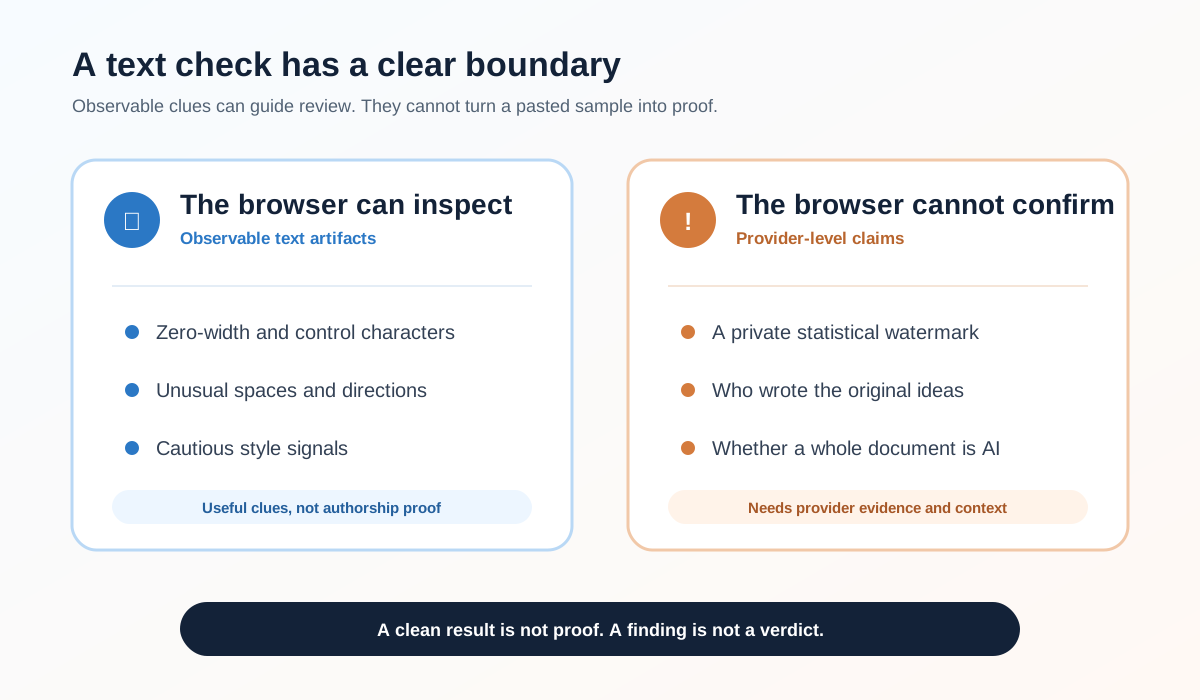
The phrase Anthropic watermark now covers several different ideas. A Claude response may carry a provider-level mark, a document may contain provenance metadata, or copied text may include ordinary hidden Unicode characters from an editor. Those are not the same thing.
The short version: Anthropic says supported Claude models can mark generated text at the model level, but a plain-text copy does not give an independent checker the private key or detector needed to confirm that statistical mark. Mydentify’s AI watermark detector checks the artifacts a browser can observe and labels the rest as unknown.
What the Claude watermark means#
Anthropic describes its new mark as an imperceptible watermark woven into the text produced by supported models. The mark is meant to survive ordinary copying and small edits without changing the visible meaning or readability of the response.
That is closer to a statistical fingerprint than a faint gray logo. The model’s token choices can carry a signal across a passage, which is why a person cannot identify it by looking at one word or by searching for a special phrase.
Anthropic also says the mark can apply when Claude edits, translates, summarizes, or reworks material supplied by a person. A detected mark therefore means Claude may have processed the text. It does not, by itself, prove that Claude created the original ideas or that a whole document was written by AI.
What Anthropic has not published#
Anthropic has not released a public, independent text detector that can verify every pasted Claude response. Without the provider’s detection method and key, a third-party page cannot honestly say that it has confirmed the statistical Claude watermark from prose alone.
This distinction matters because many pages use Claude watermark detector and AI watermark checker as if they meant the same thing. A tool that strips zero-width characters may be useful, but it is not detecting Anthropic’s model-level watermark. A style classifier is a different kind of guess again.
The official Claude guidance should be the source of truth as Anthropic publishes more technical detail. The support page’s limitations also matter: a mark is a signal about processing and provenance, not a complete authorship record.
Check pasted text for visible clues#
You can still inspect a text sample for artifacts that are observable in a browser:
- Zero-width, directional, and byte-order characters.
- Non-breaking or narrow spaces that look like normal spaces.
- Control characters that ordinary prose rarely needs.
- Simple style patterns such as repeated formulaic transitions.
Run the free AI watermark and Claude checker with a paragraph or longer sample. It keeps the check in your browser, reports each finding, and can copy a cleaned version after you review the result.
A clean result means only that this check did not find those observable artifacts. It does not prove the text was written by a person, and it cannot rule out a provider-level statistical watermark.
Why AI detectors can be wrong#
General AI text detectors usually infer authorship from patterns in writing. They may score predictable sentence lengths, common transitions, word choice, or other style features. Those patterns overlap with careful human writing, translated writing, technical writing, and text edited by several people.
Watermark detection has a different goal: verify a signal placed by a provider during generation. It can be stronger when the provider supplies a detector, but it still needs context. Claude may have polished a human draft. A copied mark may show processing rather than original authorship. A missing mark may reflect an unsupported model, a transformation, or a detection limit.
Do not use a pasted-text result as the only basis for grading, hiring, discipline, or a legal claim. Ask how the content was created, keep drafts and revision history, and follow the policy that applies to the work.
What to do with a positive result#
First, separate the finding from the conclusion. If the checker finds hidden Unicode characters, inspect the source editor and document history before blaming an AI tool. Rich text copy, PDFs, messaging apps, and accessibility features can all introduce non-standard characters.
If a provider later confirms a Claude mark, record it as evidence that a supported Claude system processed the passage. Then ask the more useful question: what does your policy say about editing, translation, summarization, and original generation?
If you need a clean publishing copy, use the checker’s cleanup action and review the result manually. Removing observable characters cannot remove a statistical watermark, change who processed the text, or turn AI-assisted work into unaided human work.
The practical answer today#
There is no honest universal Claude watermark detector that can confirm Anthropic’s private statistical mark from any pasted paragraph. There is a useful, narrower tool: inspect observable text artifacts, explain the provider-specific limit, and keep AI-style signals separate from provenance.
That is the approach behind Mydentify’s AI watermark detector. Use it to debug copy, understand what a document contains, and decide what needs review. Treat its result as one piece of context—not a verdict about a person.
See How We Checked It
We name the source, record the review date, and separate reported claims from our own checks. Read the methodology and editorial policy before citing a finding or sending a correction.
Put this guide into practice
Open the ai discovery tools hub, then choose the check that matches your next decision.
Found an outdated fact? Report a correction.
Back to articles